Update Date:
February 6, 2026
Planning your first company retreat can feel overwhelming. Whether you're organizing a team offsite for 20 people or a company-wide event, this complete retreat planning guide will walk you through every step. We've helped plan hundreds of successful retreats across Europe, and in this post, we're sharing our proven 7-step framework that turns first-time retreat organizers into confident planners.
Your first company retreat can be thrilling… or quietly disastrous. Here's how to plan a company retreat that's thrilling, not disastrous.
The executive team has BIG expectations. You've got a wide group of restless employees who've never been in the same room. You've got cross-border logistics that are getting out of hand.
It's scary. If you get it wrong, you could feel the heat.
You see, company retreat planning is too often seen as logistics. When in fact, it's a strategy. They're not corporate holidays, they're investments.
We've planned hundreds of meaningful European retreats for distributed teams, and with that experience, we've built this guide that gives you a simple framework that reduces overwhelm and sets your first retreat up for success.

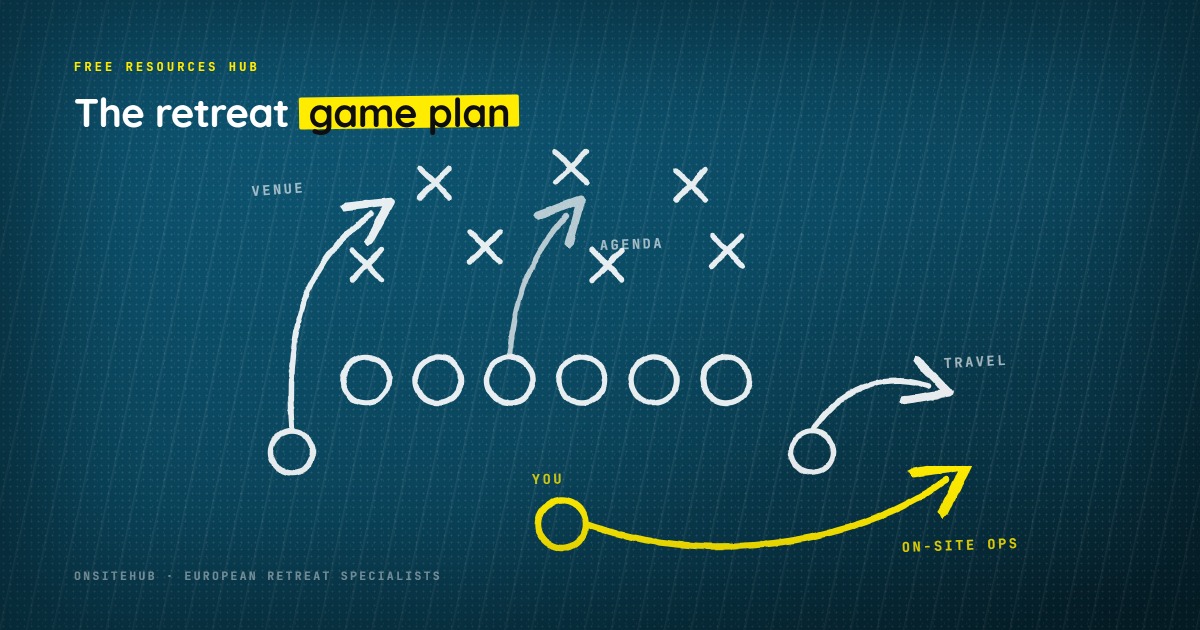
Goal → Format → Environment → Structure → Execution
Get these five levers aligned, and the retreat becomes not a gamble, but a strategic tool.
Retreats don't fail because of logistics. They fail because they have no North Star - no objective.
Before you think about venues, dates, or AV equipment, ask yourself: What is this retreat actually solving?
In our experience planning 100+ retreats, unclear objectives are the #1 cause of retreat disappointment—not logistics or budget issues.
There are a lot of common variables we help teams with: connection, alignment, focus…
But with each being a different outcome, they all have different setups. Treating all company retreats the same - or chasing multiple goals at once (huge no-no) - is the fastest way to fumble a lot of time and money.
Here are the most common, meaningful goals — and what we've learned works in practice:
The biggest mistake rookies make is trying to do all of these at once.
"We want to do everything in one retreat."
And look, we get it, it's frighteningly understandable. In work and in life, productive people are always looking to multitask. To trim the fat.
But you can't bond, align, reset, and accelerate in the same three days without sacrificing everything.
Pick one goal and build everything around it. The environment, the schedule, even the meals — all of it should serve that single outcome.
The rest becomes easier. The retreat becomes purposeful. And, if you're lucky, the unplanned moments — the beach, the hotel bar, the downtime, workshop breakthroughs — you might just find that you unlock some secondary benefits too!

Strangers to the retreat game (again, understandably) see "company retreats" as a one-size-fits-all event. A vague work trip where there are PowerPoints and a dinner afterwards - you've done one, you've done them all.
Absolutely not.
"Company retreat" is an umbrella term.
Teams that clearly define their retreat type before planning report 65% higher satisfaction scores than those who treat all retreats the same.
Not understanding that is the quickest way to quietly sink outcomes. Because the moment you treat every retreat as a generic category, you start planning an outfit that doesn't fit and that violates the dress code.
The type of retreat you're running fundamentally changes how it should be designed.
A Sales Kick-Off, for example, is about momentum and belief. It's meant to create forward motion — emotional, strategic, commercial. Put that kind of retreat into an environment that's too quiet, too reflective, or too inward-looking, and you can feel the energy drain out of the room. The setting works against the goal before Q1 even begins.
A product deep-work week is the opposite. Its success depends on calm, focus, and continuity. These teams don't need stimulation — they need space to think. Drop them into a visually loud, socially busy, or logistically complex environment and the work slows instead of accelerating. The retreat becomes tiring instead of productive.
Learn more about our corporate retreat planning services for different team types.
Team-building retreats are often misunderstood too. When they span multiple days, they're not about activities for activity's sake. They're about relaxation and reconnection — giving people permission to spend time together without performance pressure. When these are over-structured or treated like conferences, they miss the point entirely.
Leadership retreats fail in quieter, more expensive ways. If the environment doesn't feel private, comfortable, and genuinely well looked after, the hard conversations never quite happen. People stay polite. Decisions get postponed. Everyone flies home feeling "aligned" — but with nothing truly resolved.
And then there are reset weeks and All-Hands. These are meant to reconnect teams, not exhaust them. They fall apart when everything is over-engineered — when the days are packed, the logistics are painful, and people spend more energy navigating the schedule than being present with each other.
Language helps here. Phrases like:
They align expectations early and make better choices possible.
Before you think about dates or destinations, get clear on the type of retreat you're actually running. Everything else — environment, agenda, flow — should follow from that.
That's how retreats stop being generic — and start working.
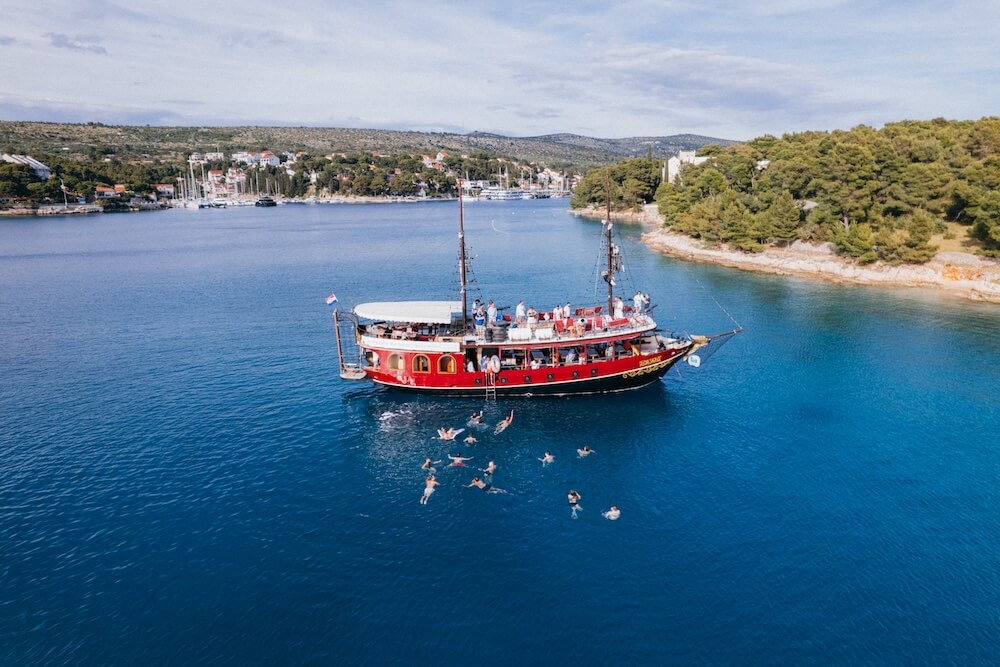
Your retreat location isn't window dressing. It's strategy.
Most first retreats don't underperform because the agenda is weak. They underperform because the environment works against the goal before the first session even begins.
We see this most clearly when teams come to us frustrated. On paper, their retreats looked solid. Clear goals. Strong agendas. Senior speakers. And yet, something never quite landed. The reason was almost always the same: the setting didn't support the behaviour the team actually needed.
QuoIntelligence chose Šibenik because everything was close, calm, and predictable. No long transfers. No noisy distractions. The environment gave the team space to work hard and recharge without losing momentum.
The location wasn't about impressing — it was about protecting focus.
Strise optimized for one shared location, minimal distractions, and real privacy. Not as a luxury, but as a necessity.
Isolation wasn't a drawback — it was the design. It created the conditions for honest conversations and real decisions to happen.

Qwello brought their team together in Italy for a summer celebration — no slide decks, just shared experiences, reconnection, and energy that could be felt by everyone.
Here, the environment wasn't about deep work or debate. It was about rebuilding the social fabric of the company.
Same ambition. Very different environments. Better outcomes — because the setting supported the behaviour each team needed.
Explore our curated European retreat destinations for first-time planners.
If you need momentum and alignment, reduce friction. Choose compact locations. Short distances. Minimal transitions. Let energy carry forward instead of leaking away.
If you need depth and trust, contain the group. One venue. Fewer distractions. Make presence the path of least resistance.
If you need reconnection across a distributed team, prioritize access over aesthetics. The best environment is the one everyone can reach and fully participate in.
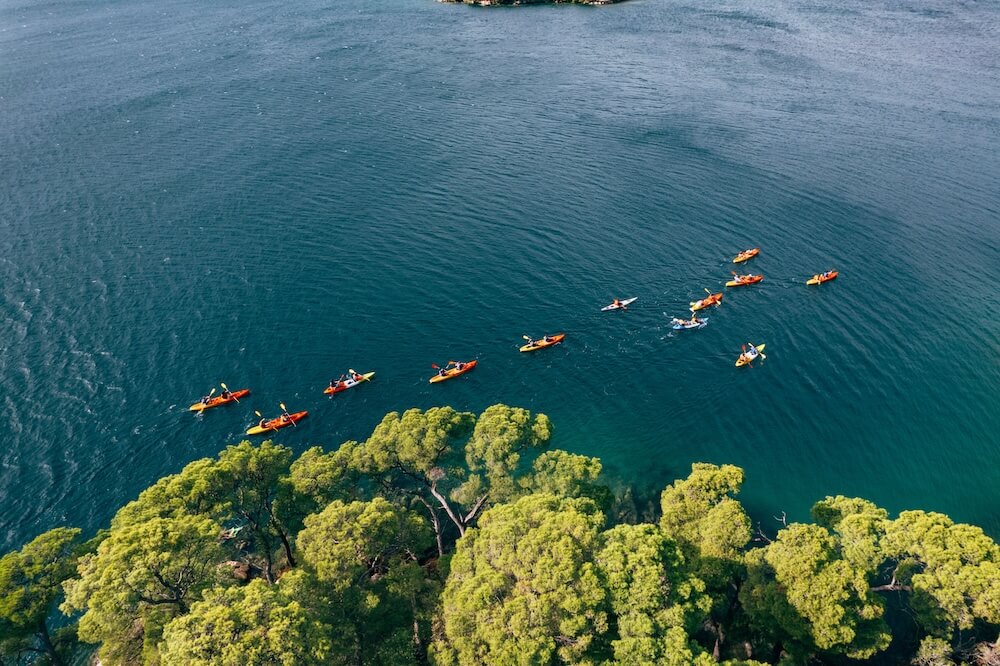
Pay attention to what the space signals:
These cues shape behaviour long before facilitation begins.
This is why we say the environment determines at least 50% of a retreat's success before anyone arrives.
Get this decision right, and everything that follows becomes easier. Get it wrong, and you'll spend the retreat compensating.
This might sound like whimsical nonsense. But the word shape helps when designing your retreat agenda and structure.
Before you schedule sessions, workshops, or dinners, decide how the days will flow. Company retreats are short, high-impact experiences. The sequence and rhythm of the days determine whether your team leaves energized or exhausted.
Here's how we think about it: start by mapping the overall retreat length, then break it into natural arcs: arrival, deep work, reflection, social connection, and downtime.
Day 1: Arrival and welcome breakfast; set objectives and expectations; short strategy session. Evening: intimate dinner to build trust.
Day 2: Morning: deep-dive workshops, problem-solving, and decision-making sessions. Afternoon: reflection and breakout discussions. Evening: social activity (walk, drinks, fireside chat).
Day 3: Morning: wrap-up, action planning, and reflection; mid-morning departures.
Day 1: Arrival, welcome session, team introductions, icebreakers. Evening: casual dinner/social mixer to set the tone.
Day 2: Morning: company updates, strategic sessions, leadership panels. Afternoon: structured team-building, collaborative exercises, optional reflection time. Evening: free or semi-structured social event.
Day 3: Morning: recap, reflection, and next-step planning. Afternoon: informal debrief or group activity, then departures.
Day 1: Arrival, kickoff workshop, alignment on goals, team introductions. Evening: light social activity to set group cohesion.
Day 2–3: Focused deep-work sessions in the morning, hands-on collaboration in the afternoon. Scheduled reflection points for feedback and iteration. Evening: optional social time for bonding.
Day 4: Present outcomes, brainstorm next steps, capture lessons learned. Evening: celebratory dinner or activity.
Day 5: Morning: buffer for wrap-up, reflection, and departures.
Day 1: Arrival, onboarding to retreat purpose, low-pressure connection activities. Evening: informal mixer.
Day 2: Flexible deep-work blocks + reflection time, interspersed with wellness or creative breaks. Evening: spontaneous social activity.
Day 3: Light collaborative workshops, storytelling sessions, one-on-one check-ins. Evening: farewell dinner.
Day 4 (optional): Optional departure or extra bonding activity, with time for personal reflection.
Structure doesn't mean rigidity—it means crafting the conditions so your goal can actually happen. When you get the shape right, the agenda almost writes itself.
Download our free sample retreat agenda templates for 2-5 day offsites.
By now, you'll already have been putting a lot of effort into this retreat. Now is a good time to align internally.
For most People Leaders, this is the true hinge point of the entire retreat. Not venues. Not flights. Alignment. Imagine all this hard work - all the daydreaming - just to be told no!?
It's the moment where excitement meets scrutiny. Where leadership leans in — and Finance inevitably asks the question everyone is thinking:
"What's the ROI?"
Not out of cynicism, of course, but responsibility. Company retreats feel intangible from the outside. Easy to dismiss as a morale perk. Harder to defend when budgets tighten.
This has been a tripping point for many a retreat with growing potential.
Trying to justify them in emotional terms alone is a dangerous gambit. And it's also not necessary. Calculate your retreat's ROI in seconds with our free Retreat ROI Calculator.
Companies that track retreat ROI report an average 3:1 return when factoring in reduced turnover, faster decision-making, and improved team alignment.
It also really helps to highlight the cost of not meeting. And for remote teams, it can be devastating.
Remote friction compounds quietly. Decisions take longer. Work is duplicated. New hires orbit on the outside for months. Burnout creeps in unnoticed. None of this shows up cleanly on a spreadsheet — but all of it slows execution.
Your people are already the business's largest investment. A company retreat isn't an extra cost; it's the strengthening of your investment.
This is also where expectations are set. Who owns the outcome. What success looks like. What the retreat is not trying to solve. When this alignment happens early, everything downstream becomes easier — including budget approval.
Once leadership is aligned — on purpose, scope, and value — booking becomes a formality. The opposite is a planning process full of tension.
Get this step right, and you can start getting excited together.

Or: why September matters more than spreadsheets
Most retreat stress isn't caused by bad planning. It's caused by late planning.
We see it every year. January arrives and the feeling hits: we should've started sooner. By then, the best venues are gone, dates are tight, prices are up. Every decision feels a little bit heavier.
That's why, internally, we treat September as the real starting line. As our co-founder Kruno puts it: "If the leaves have already fallen, you've already fallen behind."
Starting early changes everything. Qwello is a perfect example. Because planning began months in advance, we helped them build the holy grail of retreats. A full vineyard estate in Italy, in peak season, with a complete buyout — at a fair price. That outcome wasn't luck or ambition. It was lead time.
See how we planned Qwello's luxury Italian vineyard retreat with 6 months lead time.
At this stage, you don't need a checklist. You just need to handle the big rocks early:
If no one talks about logistics during the retreat, you got this step right. All they'll remember is how easy everything felt.
Not ready to handle logistics yourself? Our ready-to-book packages include everything.

When building a retreat, it's easy to get excited. You see a gap in the schedule, you want to fit in that amazing activity you discovered on Instagram. The temptation to "add just one more thing" never goes away.
Another piece to the puzzle to justify the investment. It feels responsible. It feels productive. It is usually the wrong instinct.
People cannot be "on" all the time. Social batteries drain. Brains fog. Even the most engaged teams start operating at a fraction of their capacity when every minute is spoken for. More programming does not lead to better outcomes. It often suffocates them.
What's less obvious — especially to first-time planners — is the anxiety this creates.
When a schedule is packed edge-to-edge, there's no margin for reality. A late bus doesn't just run late — it steals time from the next session. A long lunch creates tension instead of connection. People start clock-watching. Facilitators rush.
This is where experienced retreat design quietly differs.
Well-run retreats assume things will slip — and plan for it without announcing it. Transitions are allowed to stretch. Buffers absorb delays without stress and prevent the entire experience from feeling brittle.
And our secret sauce is knowing that the most meaningful moments of a retreat rarely happen during the sessions themselves. They happen around them. In the space where time runs at a slightly different speed. Where no one is being pulled toward the next obligation.
Our post-retreat surveys consistently show that 40% of 'breakthrough moments' happen during unstructured time—not scheduled sessions.
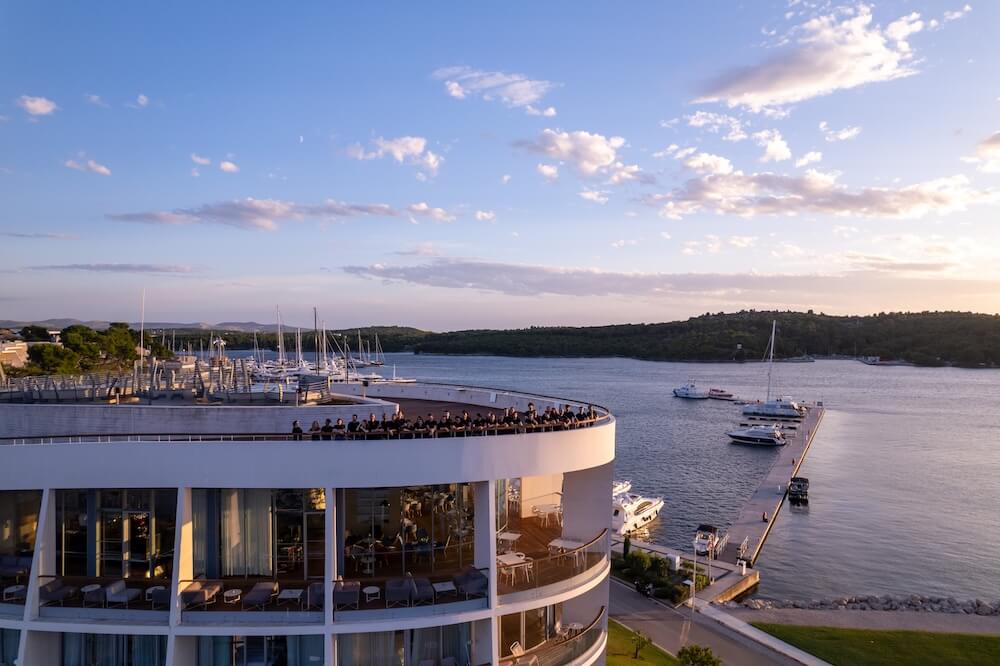
A group finishes dinner and hits the familiar fork in the road: bed, or one drink. One drink turns into a spontaneous takeover of the hotel bar. Another evening, the pool bar closes early. Staff hand out plastic cups. Someone produces Scotch, someone else opens port, a bottle of Balkan šljivovica appears from a suitcase.
White space is not wasted time (and not just an excuse to let loose on company time!). It is where trust forms, and ideas that were held back are let loose.
Company retreat costs typically range from €200-400 per person for a 3-day event, depending on location, accommodation level, and activities included. For a team of 25 people, budget €5,000-10,000 total.
We recommend starting retreat planning 3-6 months in advance for the best venue selection and pricing. Popular European destinations book up quickly, especially during spring and fall.
Most successful first retreats are 2.5-3 days (arriving evening of Day 1, departing afternoon of Day 3). This provides enough time for meaningful connection without overwhelming participants or budgets.
Professional retreat planners save 40-60 hours of planning time and often secure better venue pricing through relationships. They're especially valuable for teams over 30 people, international groups, or first-time organizers.
Trying to accomplish too many goals in one retreat. Pick ONE primary objective—alignment, connection, or deep work—and design everything around it. You can't do everything in 3 days.
You don't need to be an event planner to run a great retreat. You need clarity, structure, and intention. When the goal is clear, the format makes sense. When the environment supports the work, people arrive ready. When you shape the experience before the agenda, the retreat earns its name.
Company retreats aren't escapes. They're strategic levers.
And with the right framework, your first one won't just survive — it'll set you up for success.
Ready to start planning? Download our Company Retreat Planning Checklist or browse our pre-designed retreat packages across Europe. Need personalized guidance? Schedule a free consultation with our retreat planning team.

You brief us once. We handle venues, travel, activities and everything in between.