Update Date:
August 18, 2026
There is a moment, usually a few months after a company retreat, when somebody in Finance asks the question everyone knew was coming.
"So, was it worth it?"
It is a perfectly reasonable question. The company has just invested tens of thousands of euros getting people on planes, putting them in hotels, feeding them, and giving them a few days away from their normal working environment. Someone, eventually, wants to know what all that money achieved.
And as true as it might be, the following will not get you far in a meeting with the people who deal in numbers:
"The team really bonded."
Even if it was the most valuable thing that happened, to Finance that sounds like corporate mumbo-jumbo.
This is a good moment to think about it. A lot of companies have just come back from their May and June retreats. The photos have made their way onto Slack, everyone has returned to their routines, and the People team is already thinking about next year's budget. Now is a good time to look back.
Not to prove that every euro generated a precise financial return. That would be pretending the world is tidier than it is. The useful question is whether the retreat produced the changes it was meant to produce.
After 100+ retreats, we have learned that the companies who answer that question most convincingly are rarely the ones with the most sophisticated reporting. They are the ones who knew what they were trying to change before anyone arrived.
.jpg)
Most retreats do not fail the ROI test because they were badly organised. They fail because nobody decided what success looked like in the first place.
The objectives tend to sound like better collaboration, stronger culture, improved alignment, more connection. All sensible reasons to bring people together, but broad enough to mean almost anything, and therefore nothing.
Then the retreat happens. People have a great time. The post-event survey comes back with an average score of 9.1. Everyone agrees it was a success.
Six months later, someone asks what changed. That is when the problem becomes obvious. There was no baseline.
Nobody measured the thing before the retreat, so there is nothing to compare it against afterwards. Nobody defined what "better collaboration" actually meant, so there is no clear way to tell whether collaboration improved. Nobody assigned owners to the things discussed, so there is no easy way to check whether the decisions survived contact with the real world.
The only evidence left is how people felt about the experience. That is useful. It is just not enough. A good retreat should make people happier to work together. But if that is the entire business case, you are asking Finance to approve a very expensive morale booster.
The easiest way to measure retreat ROI is to work backwards from the reason you held it.
If the problem was strategic confusion, measure strategic clarity. If decisions were taking too long, look at decision velocity. If departments were not working together, look at what happened to cross-functional projects afterwards. If the concern was retention or engagement, look at those numbers over a longer period.
The measurement follows the objective, not the other way around.
This is why we prefer a small number of meaningful measures over a giant post-retreat dashboard. You do not need twenty KPIs to prove a three-day gathering worked. You need three to five things that tell you whether the original problem improved.
And because we are talking about something that has already happened, you can start with what you have. If you want a structure for that, our retreat ROI calculator gives you a practical way to frame the numbers without pretending they add up more neatly than they do.
For strategy or leadership retreats, one of the strongest measures is also one of the simplest: look at what was agreed and see what happened afterwards.
Most leadership teams leave a retreat with a list of priorities. The real test is whether those priorities survived the following 90 days. Go back to the notes.
That last category is often the most revealing.
It is easy to leave a retreat feeling that something important happened because a room full of senior people spent three hours talking about it. That feeling is not imaginary, but the conversation only becomes valuable when it changes what happens afterwards.
If the team agreed five priorities and four were delivered or substantially progressed within 90 days, you have a useful piece of evidence. Not proof that the retreat alone caused those four things. There are always other factors. But it is a credible link between the investment and a tangible business outcome.

This matters for distributed companies. One of the less glamorous costs of remote work is the friction that accumulates around decisions.
We have all lived through this. A question gets raised in Slack, moves into a meeting, gets kicked into another meeting, somebody asks for more information, someone goes on holiday, and eventually the original question returns three weeks later wearing a slightly different hat.
Bringing people together does not automatically solve that, but it can remove some of the friction.
If decision-making was one of the reasons for the retreat, look at it properly. Take a sample of decisions before the retreat and compare them with similar decisions afterwards. How long did they take from proposal to agreement? How many rounds of asynchronous discussion were involved? How often did decisions have to be revisited because people had not understood the original conclusion?
You might find the numbers barely moved. That is useful too. ROI measurement is not about finding a positive result at all costs. If the retreat did not improve the thing you hoped it would, that is worth knowing before you spend another €100,000 solving the same problem the same way next year.
Collaboration is another word that becomes suspiciously vague when it reaches a budget meeting. So do not measure collaboration. Measure what collaboration produced.
If Product, Sales, and Customer Success were struggling to work together, did they launch a new cross-functional initiative afterwards? Did a project that had been stuck finally move forward? Did teams start working on something that did not exist before the retreat?
A 60-day window works well here. Long enough for the conversations to turn into something real, short enough that you can still reasonably connect the outcome to what happened.
Imagine a retreat designed partly around improving the relationship between Sales and Product. During the retreat, the two teams agree to create a joint customer-feedback process, with an owner from each department and a 60-day deadline. Two months later, the process is live and being used.
That is a far more interesting result than saying the two teams "felt more connected." The connection still matters. But now it has produced something tangible, and now you have something to put in front of leadership and Finance.
.png)
This is where things get less tidy.
Employee engagement, eNPS, and retention are useful measures, particularly when the retreat was explicitly intended to strengthen connection or reduce the risk of people drifting away. They are also very difficult to attribute to one event.
If eNPS increases after a retreat, you cannot reasonably write, "The retreat increased eNPS by 14 points." The company might have hired a new leadership team, launched a new product, given everyone a pay rise, or simply had a good quarter. There are too many variables.
That does not make the number useless. It means you treat it as a signal, not a verdict.
Look at the movement before and after the retreat. If you have comparable data, look at the same period the previous year. Most importantly, look at whether the change lasts.
The immediate post-retreat survey is often inflated by recency. Everyone has just spent four days in the sun eating good food and talking to colleagues they normally only see on Zoom. Of course they feel positive.
Six months later is more interesting. If engagement stays higher, retention improves, and the team is delivering against the priorities agreed at the retreat, you are starting to see a pattern. That is the sort of evidence that becomes useful to leadership.
There is one area where a simple pre- and post-retreat survey can be genuinely powerful: clarity.
The trick is to ask useful questions.
"How much did you enjoy the retreat?" tells you whether people enjoyed the retreat.
"How confident are you that you understand the company's three most important priorities for the next quarter?" tells you something about the business.
You might also ask how confident people are in understanding their team's role in the strategy, whether they know which decisions have been made, or whether they know what is expected of them over the next 90 days.
Ask before the retreat. Ask immediately afterwards. Then ask again after 60 or 90 days. You can then see whether the improvement was simply the effect of everyone being in the same room, or whether it stuck.
This is much closer to measuring the thing a retreat is often supposed to achieve: not making people feel good about the company, but helping them understand where it is going and what they are supposed to do about it.
There is still a place for the traditional post-retreat feedback form.
You should find out whether people liked the hotel, whether the location worked, whether the food was good, whether the activity was worth repeating, and whether the schedule left people exhausted. Those things matter. If you are running another retreat next year, this is your chance to improve the product.
Compare the feedback with previous years. Was the accommodation better? Did the location make movement easier? Did people rate the working environment more highly? Did the activity actually help people connect, or was it something everyone endured before dinner?
Keep the distinction clear. "People loved the retreat" is a measure of the experience. "The retreat changed something we cared about" is a measure of its business value. You want both.

Ideally, none of this is invented after the retreat.
The best time to decide how you will measure success is when you are still deciding what the retreat is for.
Before the event, choose three to five outcomes that matter. Record the baseline wherever you can. If you are measuring clarity, ask the questions. If you are measuring decision velocity, record the current numbers. If you are trying to improve cross-functional work, document what that work currently looks like.
Then build those outcomes into the retreat itself. A strategy session should not end with "great discussion." It should end with decisions, owners, and deadlines. A cross-functional workshop should produce something that can be checked later. A leadership conversation about priorities should result in priorities that can actually be measured.
This is one of the things that separates a retreat that looks strategically important from one that actually is. The agenda is not just a timetable. It is the beginning of the measurement.
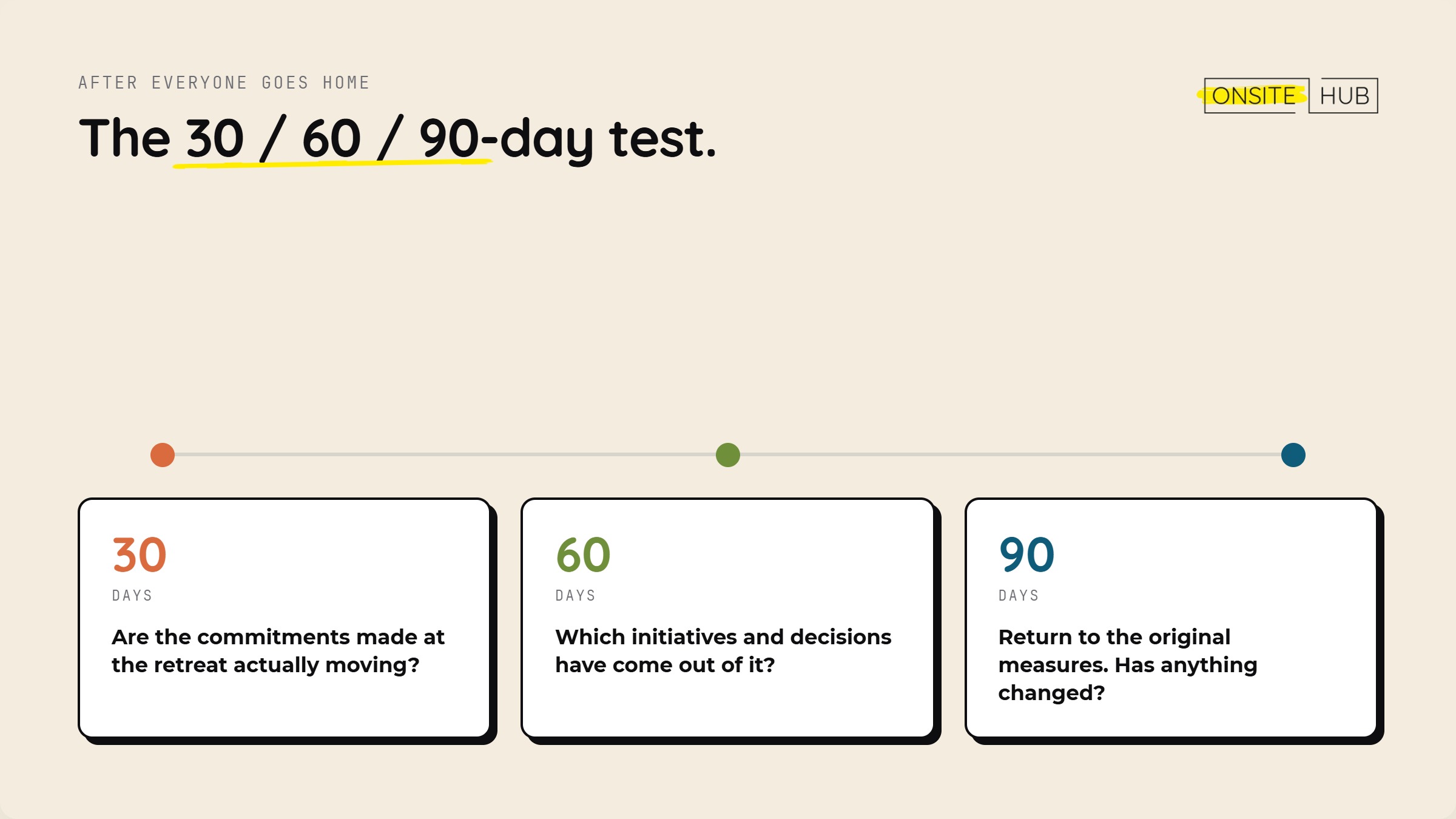
Once everyone has gone home, the work is mostly about following the thread.
At 30 days, check whether the commitments made at the retreat are moving. At 60 days, look for the initiatives and decisions that came out of it. At 90 days, return to the original measures. Has anything changed?
You do not need a new reporting function to do this. A one-page executive summary is usually enough. Start with the objective. Show the baseline. Show what happened. Show where things stand at 90 days. Then add the things that need longer-term tracking, such as engagement or retention, and revisit them at six or twelve months.
That gives you something remarkably useful for the next budget meeting. It is also the backbone of a proper internal case for the next retreat, which is exactly what our Business Case Template is built to help People teams put together.
There is a big difference between saying:
"The retreat was a huge success. Feedback was overwhelmingly positive, and employees really valued the chance to connect in person."
and saying:
"The retreat was designed to improve cross-functional execution between Product, Sales, and Customer Success. Before the retreat, teams scored confidence in shared priorities at 6.1/10. Three cross-functional priorities were agreed during the retreat, each with a named owner. At 60 days, two new initiatives had launched. At 90 days, four of the five agreed priorities were completed or on track, and clarity around company priorities had increased to 8.0/10."
The first tells the board people had a nice time. The second gives them a reason to believe the investment achieved something.
That is what you are building. Not a perfect ROI calculation. A credible chain between the problem you had, the reason you brought people together, the change you wanted to create, and the evidence that something actually moved.
There is an understandable temptation to reduce the whole thing to a single calculation. We spent €100,000 and generated €150,000 of value, therefore the retreat delivered a 50% return.
It would be lovely if it worked like that. It does not. Some benefits are immediate. Some take six months. Some are difficult to put into euros without inventing a number that looks impressive in a spreadsheet and means very little in reality.
The goal is not to pretend otherwise. It is to measure the things that genuinely matter. If the retreat was supposed to create strategic clarity, measure whether clarity improved. If it was supposed to accelerate decisions, measure decision-making. If it was supposed to get teams working together, look at what they built together afterwards. If it was supposed to strengthen retention, track the people data over time.
And if it was simply supposed to give a distributed team the chance to spend meaningful time together, measure that too. Just do not pretend a 9/10 happiness score is the same thing as business ROI.
After 100+ retreats, we have found that the strongest business case is not the one with the cleverest calculation. It is the one where the company can look back three months later and say: this is what we wanted to change, this is where we started, this is what happened, and this is what is different now.
That is a much easier conversation to have when the CFO asks, "Was it worth it?"
.jpg)
If you are still working on the internal case for your next retreat, our Business Case Template helps People teams turn the argument into something Finance can actually work with.
And once the budget is approved, the Retreat Budget Tracker gives you a clearer view of where the investment is going, from the first quote to the final invoice.
Both are available in the OnsiteHub Resources Hub.
And when you are ready to plan the retreat itself, that is where we come in. We build retreats around the outcomes you are trying to reach, then handle the venues, logistics, and suppliers so your team can focus on the work that made the retreat worth running. Tell us your team size, your rough dates, and what you want to change, and we will take it from there.
Plan your next retreat with OnsiteHub

You brief us once. We handle venues, travel, activities and everything in between.