Update Date:
September 24, 2026
We've planned more than 300 retreats. The ones that fall apart are almost always missing the same document.
Not the agenda. Not the budget.
It's the least glamorous document in retreat planning. Nobody gets excited about a spreadsheet full of timings and contact details. But it's the one that actually makes or breaks the retreat.
The Run-of-Show.
Our planners use the same template on every single retreat we run. It's the working document the whole show is built on.
And we're giving it away. This guide covers the why and the how. Download it at the bottom.
A run-of-show is the detailed working schedule used to coordinate a live event or retreat. It sets out what happens, when it happens, who is responsible, what needs to happen before the next activity, and what to do if something changes.
The easiest way to think about it:
The agenda tells you what happens. The run-of-show makes sure it happens.
An agenda might say:
A run-of-show goes further.
That extra detail is what turns a nice itinerary into something you can actually run.
Consider the difference between an architect's drawing and a construction schedule. The drawing shows you what the building will look like. The construction schedule makes sure it actually gets built: that the steel arrives on time, the electricians know where to run cables, and the inspectors show up before the walls close.
Your agenda is the drawing. Your run-of-show is the construction schedule.
Here's what happens without one:
The coach that arrives mid-lunch. Transport is booked for 13:00, but lunch started late and the group is still eating. The driver is waiting outside. The restaurant is trying to clear plates. Nobody is sure whether to rush the meal or hold the coach. Without a run-of-show, this becomes a fifteen-minute argument in the car park. With one, the ops lead already knows the coach can wait until 13:20 and the next session has a built-in buffer.
The facilitator who doesn't know the room flips to dinner in 20 minutes. They're mid-flow, the group is engaged, and they want to run over. But the venue needs the room back to reset for dinner. Without a run-of-show, someone has to interrupt awkwardly, or the dinner service slips. With one, the facilitator knows the hard stop before they start — and builds the session around it.
The AV nobody tested until the CEO is on stage. The laptop doesn't connect. The clicker doesn't work. The screen is the wrong resolution. This is the moment a retreat loses its polish, and it's entirely preventable. A run-of-show flags every AV item as Confirmed before travel day. If it isn't tested, it isn't ready.
And it’s all very avoidable. Just follow our run of show document.
This is the doc our planners actually use. It’s not an empty PDF with a logo.
The single source of truth for the basics:
This tab gets filled in first, because every other tab depends on it.
This is the tab that keeps the run-of-show honest.
If a session doesn't serve an objective or protect a must-happen moment, it shouldn't be in the schedule.
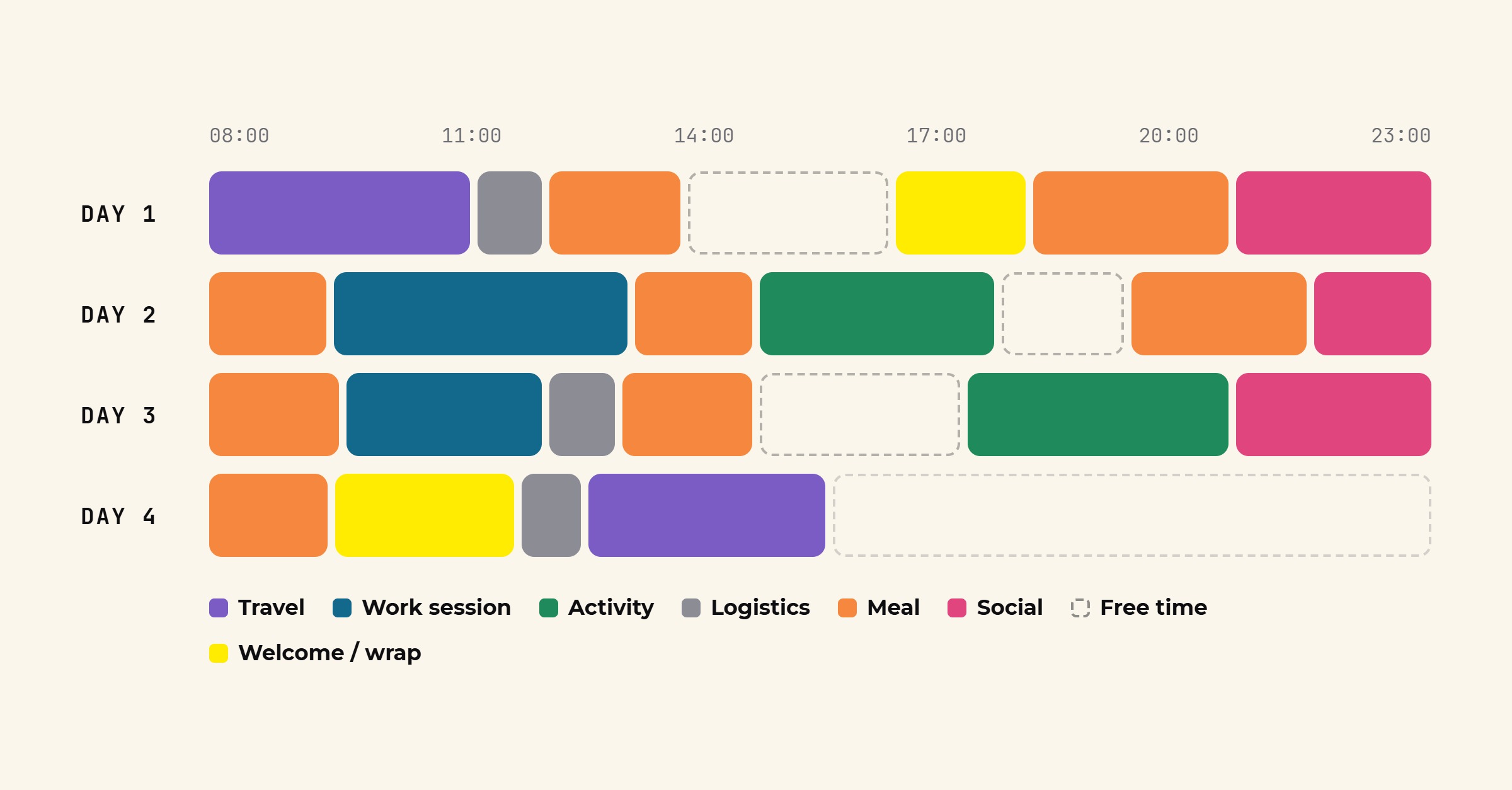
The heart of the document. The command centre. The Schedule.
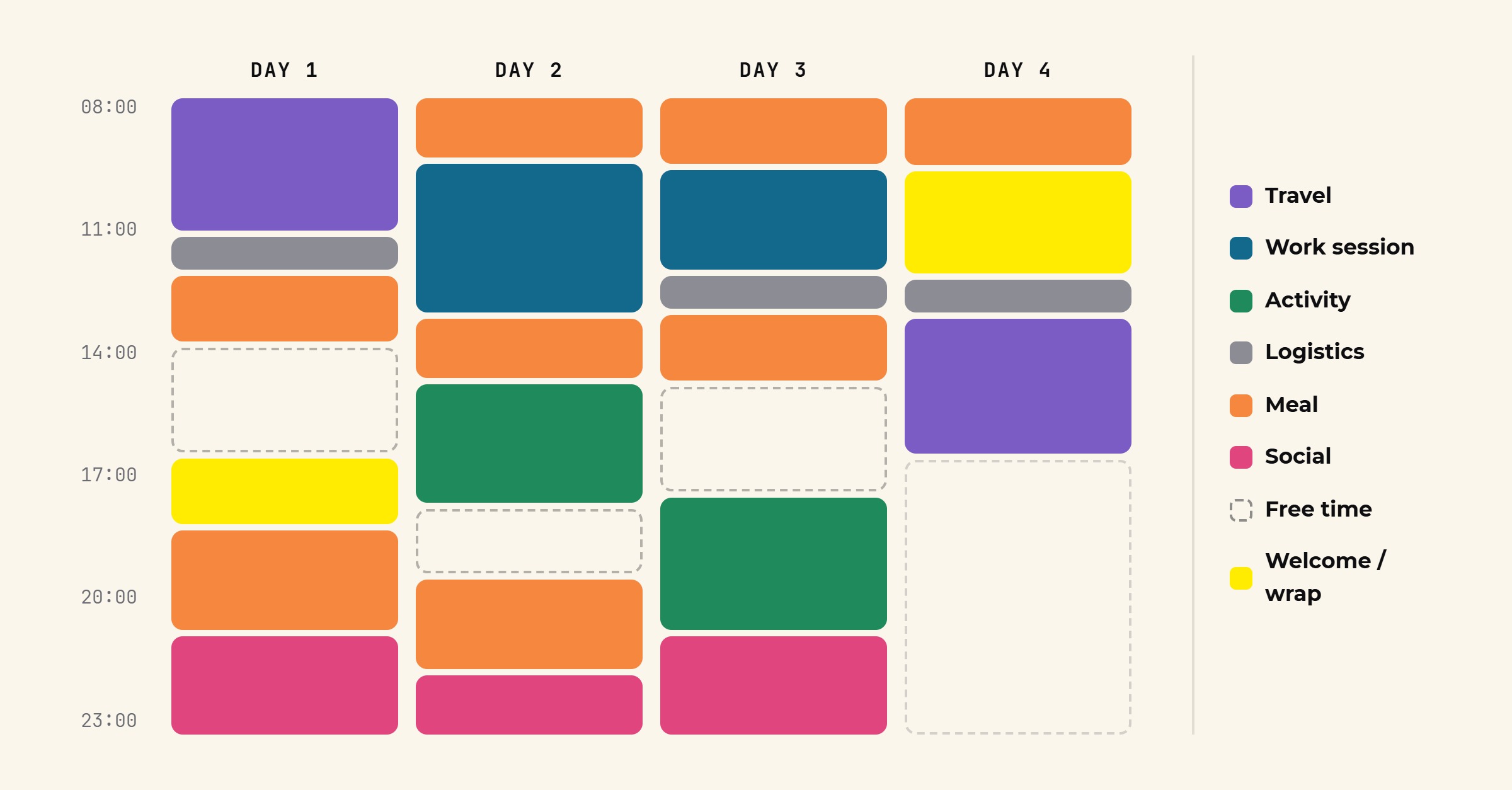
Built day-by-day in 15-minute blocks. Every block is colour-coded by activity type.
The shape of the day is visible at a glance. This is where a packed agenda becomes obvious.
If the schedule is a wall of colour with no white space, the problem isn't the spreadsheet. It's the plan.
Every human involved:
If the answer is "someone from the team," you haven't gone far enough.
Every moving part needs a name and a number.
The single source of truth for kit. What's needed, who's bringing it, where it is, and - critically - whether it's Confirmed. Nothing travels without being marked Confirmed first.
We said at the top of the show that this wasn’t the most exciting document we work with. This section we plug in a lot (A LOT) of details. For every transfer:
If a transfer isn't in the log, it isn't happening.
Emergencies can and will happen. But “Keep Calm and Carry on”, as the British love to say.
But this part is very important, as we have discovered IRL, so we’re going to say this in bold: The tab that must be printed and carried by the ops lead.
Because phones, laptops, WiFi, and Slack apps can fail when you most need them. Meaning that piece of paper is an extra peace of mind.

This is where the value of a detailed run-of-show becomes obvious.
At a recent retreat in Lisbon, our client IFT was bringing together more than 150 people while running three things at once: a company all-hands, an external festival, and dedicated internal team time.
Then the world intervened. The day before the retreat, flights were suddenly disrupted following attacks on airports in the Middle East. People were stranded, connections disappeared, and travel plans changed overnight.
The original itinerary was no longer enough. Our team had to work out who was still travelling, who needed to be rerouted, who could join virtually, and who needed support on the ground. One attendee eventually spent 32 hours travelling from Australia to Lisbon by planes, trains, and buses.
The important thing is that the retreat itself didn't become the airport problem. People still arrived to a calm experience.
That's what the operational layer of a retreat is there for. The schedule doesn't stop existing because reality has changed. You need a working document that helps the people running the retreat adapt it without losing sight of everything else happening around it.
The same retreat brought another very different problem. IFT has a tradition of bringing Brazilian Jiu-Jitsu mats to its retreats for informal training and to donate locally afterwards. Their supplier stopped responding.
So our team went looking. We tracked down martial arts shops across Lisbon, found a shop with the right number of mats, negotiated for them to be released, then had to solve the transport problem when the vehicle available wasn't suitable.
The mats arrived in time. To everyone attending, the activity happened exactly as planned. The best retreat operations are often invisible.
Don't wait until the week before your retreat to create your run-of-show. The document becomes more useful as your retreat gets closer, but the thinking behind it should start much earlier.
*N.B. The earlier you start planning your 2027 retreat, the more useful this document becomes.
Work out the major pieces: who is coming, where they're staying, how they'll arrive and move around, what needs to happen during working sessions, which suppliers or facilitators are involved.
*P.S. Your retreat budget should be taking shape alongside this planning, so you can see where the operational decisions are affecting the overall cost.
Where are the points in the day most likely to become complicated? Transfers. Room changes. Tight transitions. External suppliers. Weather-dependent activities. Anything involving 80+ people moving at once.
This is where a run-of-show can expose problems in your retreat plan.
If you've scheduled breakfast, a 90-minute workshop, a room change, a group transfer, and lunch in a two-hour window, the problem isn't your spreadsheet. The problem is the schedule.
And it's much better to discover that while you're planning in 2027 than when 100 people are standing outside a conference room waiting for someone to find the key.
The same principle applies when your plans change.
Fonoa's Dubrovnik corporate retreat started with an expected headcount of around 130 people. By the time the retreat arrived, there were 206.
That isn't a small amendment. More people means more rooms, more transfers, more restaurant seats, more workshop space, and more things to keep track of.
A run-of-show isn't a document you create once and never touch again. It should evolve as the retreat does.
Before you finalise, run through this:
If you can't answer yes to most of those, the run-of-show isn't finished.
The best run-of-show does something slightly counterintuitive. It makes itself unnecessary to everyone except the people running the retreat.
Your employees shouldn't need to know which supplier is arriving at 08:15. They shouldn't need to know who is waiting at the restaurant. They shouldn't be worrying about whether the room has been reset for the next session.
They should be able to walk into the room, grab a coffee, and get on with the day. The retreat your team remembers is built in a lot of moments they never see.
That's why the run-of-show matters. It gives the people behind the scenes a shared view of the day, makes responsibilities clear, and gives you somewhere to adapt when the inevitable happens.
At OnsiteHub, this is the kind of operational detail our planners work with every day. We've seen what happens when a transfer takes longer than expected, a supplier disappears, a headcount changes, or the weather decides it has other plans.
The best run-of-show does something slightly counterintuitive. It makes itself unnecessary to everyone except the people running the retreat. Your team just walks in, grabs a coffee, and gets on with the day, while everything holding that experience together stays out of sight.
That's the job of the document. Not to impress anyone. To make sure nothing you've planned falls apart when reality doesn't cooperate.
Download the free Run-of-Show Template
And if you're still building the shape of the day itself, pair it with our Agenda Template. The agenda tells everyone what the retreat looks like. The run-of-show makes sure it actually happens. Get the Corporate Retreat Agenda Template
Talk to us about planning you next corporate retreat
Getting the agenda right and building a run-of-show to match it is exactly the kind of work our planners do every day, on every retreat, for every client.
If you'd rather not build either from scratch, that's what we're here for.
Talk to OnsiteHub and let's plan your next retreat properly, from the shape of the day to the details that keep it running smoothly.

You brief us once. We handle venues, travel, activities and everything in between.