Update Date:
September 1, 2026
AI is polarising. Either it's the end of the world, or the door to digital utopia.
Here's what we actually know: AI is already pretty good at planning a company retreat. If you know which buttons to press.
Give ChatGPT a few objectives and some constraints. Seconds later, you've got an agenda. Ask for activity ideas and you'll have fifty. Tell it you're taking 80 people to Croatia and it'll hand you venues, restaurants and things to do.
That's genuinely useful.
It's also where people get into trouble.
AI can help you plan. It knows the internet. What it can't give you is the truth. The reality on the ground.
It reads that a venue has a "beautiful terrace." It doesn't know that beautiful terrace overlooks the delivery yard.
It doesn't know the "30-minute transfer" takes two hours once you add 80 people and their luggage. That the Wi-Fi collapses when it rains. That the restaurant's "private room" isn't actually private. That the coach company has a habit of turning up 20 minutes late.
We've planned 300+ retreats. We've seen enough of both sides to know where AI saves you time, and where you still need a human who knows what they're looking at.
So keep it simple.
Use AI for the thinking it's good at. Don't ask it to replace the experience it doesn't have.

Let's start by giving AI its due. Its biggest virtue is that it saves you time.
And offsite planning can be incredibly time-consuming. A lot of stuff that needs done that isn’t all that complicated.
The bits and pieces it takes to turn a blank page into a workable first draft.
This is where AI is a bit of a God send.
It’s like, everyone can sit and poke holes in a movie. But not everyone can actually make a movie.
So, you might now be able to build an entire first draft of an offsite. But if you have one in front of you then you can definitely make it better, right?
And this first step is simple. You just have to tell the machine what you already know, and it will give you something back that is more useful.
Let’s look at an example:
AI can turn that mess into a first draft. And importantly, you can give it constraints.
Try something like:
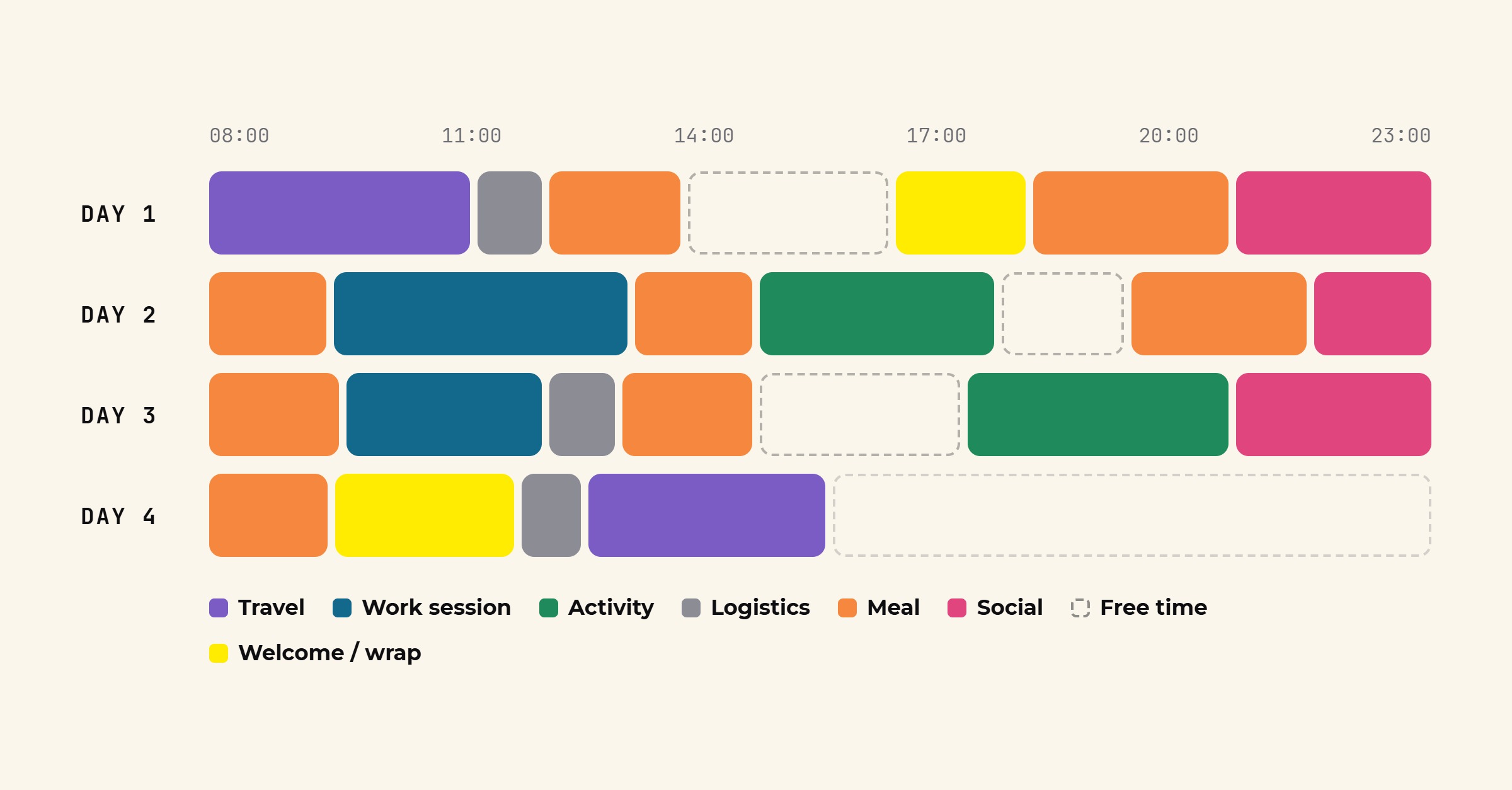
Design a 3-day company retreat agenda for 60 people. Our objectives are: align on the next six months of strategy, improve cross-functional collaboration and give the team meaningful time together. People arrive at 14:00 on Day 1 and leave at 15:00 on Day 3. No work sessions after 17:00. Include one full-group activity per day, a maximum of 30% breakout sessions and at least one completely free evening. For every session, explain why it belongs where you've put it.
That last instruction is important. If AI can't explain why a session belongs in the agenda, there's a decent chance you've just invented something to fill a gap.
A well-structured prompt can get you surprisingly close to a useful first draft, without spending two hours staring at an empty spreadsheet. The OnsiteHub Prompt Library uses this kind of objective-and-constraint approach for first-draft agenda building.
You still need to edit it. You always need to edit.
But editing a decent first draft is much easier than creating one from nothing!
This is probably AI's most underrated retreat-planning superpower. You don't necessarily need it to produce the finished thing. You just need it to give you somewhere to start.
Struggling with the retreat theme? Ask for 20 possibilities.
Not sure what your welcome dinner should feel like? Give it the destination, group size, budget and desired atmosphere and ask it to suggest formats.
Need to explain why the company should spend €60,000 bringing everyone together? Ask it to structure the argument.
The answer it gives you doesn’t have to be perfect. It just has to give you push in the right direction and get you started.
For those juggling a full time job with its 47 evolving tasks, that can be a pretty valuable thing.

A business proposal for a company retreat is a great example of where people and AI can work together to make something better than either one could do on their own.
AI knows the nuts and bolts of how to build one. So do you, we’re very sure. But AI does it faster and puts the raw ingredients that only you know together for you.
You know the problem the company is trying to solve. You know roughly what the retreat will cost. You know what you want the team to achieve.
AI can help you turn those ingredients into an argument.
For example:
Help me structure a business case for a €75,000 company retreat for 80 employees. The retreat is designed to improve strategic alignment, accelerate cross-functional decision-making and strengthen connection across a distributed team. Include the business problem, why an in-person retreat is the proposed solution, expected outcomes, risks, costs and how we will measure success over 90 days. Do not invent financial returns. Flag where I need to provide evidence.
That's a much better use of AI than asking:
"Why are company retreats good?"
The first prompt gives it something to work with. The second invites corporate waffles.
And finally, with an edit, you can fine tune it to who you’re pitching it to. You know the company and more importantly the people.
This one is a homerun. AI is excellent at the brainstorming stage of activity planning.
Give it your actual constraints:
And ask for ideas.
You can then interrogate the list.
"Which five would still be fun if it rained?"
"Which three create natural interaction between people who don't normally work together?"
"Remove anything that feels like corporate team-building."
Suddenly you're having a useful conversation rather than scrolling through pages of generic activities.
That's all the good stuff.
This is where offsite planning distinguishes itself as an art, compared to many other kinds of planning.
You see, AI is amazing at taking the sum total of all the relevant information of a thing and giving you back the average of it.
But retreats are full of context. And context is where things get messy.
Ask AI to find eight venues for your retreat and it can produce a beautifully formatted shortlist.
It all looks very convincing. Seductively convincing. It makes us think that the work is done. Tick the box and move on.
But AI cannot walk through the front door.
That's the distinction.
AI can help you find options. Someone still needs to check whether they're any good. That’s where planning a rereat with local expertise becomes important!

Logistics. Yeap. That unpredictable monster. Anyone who has travelled anywhere ever knows that sometimes it’s just not your day. When offsites go wrong, logistics are usually the thing.
AI sees a map. It seems that the journey from the airport to the venue is 30 minutes. Great. Except you're not moving one person in a taxi.
AI doesn’t feel the weight of a heavy bag against an uncooperative ground. It doesn’t feel fatigued after delayed flights and two transfers. It doesn’t feel the anxiety of trying to navigate vague instructions in an airport that is not signposted in their language.
You're moving 80 people who have just landed from seven different cities, collecting luggage, finding the coach, waiting for the person whose suitcase hasn't arrived and trying to leave an airport car park with three buses at once.
The theoretical journey time and the actual group transfer are two very different things.
AI can help you structure the transfer plan. It can group arrivals into windows, calculate shuttle capacity and suggest buffers.
It cannot stand at the arrivals gate and tell you that the coach driver has gone to Terminal 2.
That's where experience matters.
AI can write a beautiful agenda. It can even make the timings mathematically work.
That doesn't mean the agenda works for humans.
It’s like a long car journey. The destination is 400 miles away and the speed limit down the motor way is 70mph.
The machine sees the schedule. An experienced planner sees the friction between the lines. That's why a good AI-generated agenda is a starting point, not the finished product.
There's one more reason not to blindly trust what AI gives you: sometimes it simply makes things up.
This isn't unique to retreat planning. It's one of the fundamental problems with generative AI.
We all know people like AI, actually. It can produce something that sounds completely confident, specific and authoritative while being completely wrong.
Lawyers have famously submitted AI-generated court filings containing cases that didn't exist. In one recent case, lawyers were fined after submitting fake quotations and citations generated by AI without properly checking them.
And that's the slightly terrifying thing about hallucinations. The answer doesn't look wrong. It looks finished. That's why the rule is simple: AI is a tool, not a source.
And if it gives you a wonderfully convincing reason why something is a brilliant idea, ask yourself whether it actually knows that, or whether it just knows how to make a convincing argument.
We actually tested this. Not theoretically. We gave an AI travel planner a real retreat brief we'd received from a client and asked it to plan the whole thing.
The brief was for 80 people in Southern Europe, with sunshine, beaches, outdoor activities, a balanced budget and a high-quality experience.
The first sign that things were going off the rails? It opened the retreat plan with a picture of a bride and groom. That gave us all a good laugh in the slack chat. But could you imagine if we sent that unchecked to a client?!
Then came the destination: Marbella in June. On paper, it made sense. Beautiful, sunny, plenty to do. In reality though, it is crowded, expensive and busy with tourists.
We'd look further inland towards Mijas instead. It's close enough to the beaches and Málaga airport, but quieter, more manageable and better suited to the kind of retreat we'd actually want to create.
Then came the accommodation… The AI pulled options from booking sites, including an apartment that technically slept five people. Technically. The reality was double beds, pull-out couches and a single bathroom. It also completely ignored the brief's requirement for four-star accommodation.
Then the activities. We'd asked for experiences suitable for 80 people: sailing, windsurfing, e-biking and similar activities. The AI came back with a wine tasting for six and a tapas tour for twelve. At one point, it suggested a full-group tapas tour for €90 total. For 80 people. The maths was not mathing.
And when we asked it to revise the suggestions, it cheerfully came back with essentially the same list. That's the problem with letting AI run the whole process. It can take a brief and produce something that looks like a retreat plan. It just doesn't necessarily understand what the retreat actually needs.
.jpg)
The funny thing is, this experiment also showed exactly why experienced retreat planning still matters.
We recently planned a company retreat on Brač, a remote island in the Adriatic, for 80 people. Restaurants there can only accommodate around 50 people.
So we didn't simply find a restaurant that could seat 80. We created two dinners: one at sunset on the beach, and another in an olive grove under the stars.
That's not something you necessarily find by searching harder. It's something you make happen because someone knows the destination, knows the people and knows what is possible. It’s a result of local experts flexing their knowledge and their connections.
The same thing happened with a ParkBee retreat. Dinner finished around 11:30pm and the group wanted to keep going. It was May, in a tiny island town where everything was already closed. Our local partner Maja made one phone call to the only pub in town. They stayed open until 2am.
Long live local experts!
At another retreat in Greece, an attendee travelling with their baby ran out of nappies. Iva simply went to a local shop, found the right size and brought them back.
And in Kotor, when a guest seriously injured herself and was taken to hospital without her Spanish-speaking son, Iva and Milana followed them to two hospitals and stayed until 3am, translating, advocating and making sure the family stayed together.
These things were in the itinerary. These weren’t things you can achieve with a prompt. That's what retreat planning actually looks like.
It's not just picking a venue or filling a schedule. It's making sure the dinner feels like magic. That the party doesn't end too early. That everyone feels safe, seen and supported.
AI can help with the planning. It can't touch the reality.
Okay, so we know AI can be good, but we also know it can be bad. And knowing that, we can now make it - and ourselves - better.
Because once you understand the boundary, AI becomes a very useful planning assistant.
Here are four types of prompts worth stealing.
Use this when you know what the retreat needs to achieve but don't know what the days should look like.
Design a {N}-day retreat agenda for {N} people. Our objectives are {objectives}. People arrive {time/day} and depart {time/day}. Constraints: {constraints}. Include {number} full-group sessions, {number} breakout sessions and {amount} of unstructured time. No work sessions after {time}. For every session, explain what it is designed to achieve and what should exist at the end of it.
The final sentence is doing a lot of work.
You're asking AI to think about outcomes rather than simply filling blocks in a calendar.
The Prompt Library's agenda prompt uses the same principle, asking for justification behind each session so filler becomes easier to spot.
AI is very good at generating icebreakers.
It's also very good at generating terrible icebreakers.
The trick is to give it enough context.
Give me 10 icebreakers for a first-night company retreat with 45 people who mostly know each other professionally but haven't spent much time together socially. The group is mixed in age and personality. Nothing should involve forced vulnerability, public speaking or embarrassing people. Each activity should take 10-20 minutes and work without slides or technology. Explain why each one works in this setting.
Now you're not asking for "fun icebreakers".
You're giving it a room full of actual humans.
You can make the prompt even more specific:
"Remove anything that feels like a corporate team-building exercise."
That usually improves things considerably.
.jpg)
This is where AI can save an enormous amount of research time, provided you understand that the shortlist is a shortlist.
Try:
Find 5-8 retreat venues in {region} for {N} people for {N} nights in {month}. Requirements: on-site accommodation, one plenary room for {N}, {N} breakout rooms, on-site food and beverage, and less than {X} hours from the nearest airport. For each venue, give me capacity, airport distance, distinctive features, public price information if available, and any obvious reasons it might not work.
Then investigate.
Don't book.
AI can help you narrow a universe of possibilities into something manageable. It can also help you build a weighted comparison between shortlisted venues, covering things like access, food, breakout flexibility, accessibility, price and vibe.
But the final scores still need human eyes.
This is perhaps the easiest one to make useful.
Give AI the things that usually get left out.
I'm planning a 3-day retreat for 70 people in {destination}. The team wants something social but not competitive. We have a mixed range of mobility levels and don't want anything that feels like forced team-building. We have €75 per person and two hours available on the afternoon of Day 2. Give me 15 activity ideas that are genuinely connected to the destination. For each, explain the experience, approximate logistics, what could go wrong and who might not enjoy it.
That final question is an interesting one.
AI is often too eager to tell you why an idea is brilliant.
Ask it what might go wrong.
You'll get a much more useful answer.
There is a temptation, particularly when you're planning your first retreat, to think AI can now do the whole thing. It can't. Which is a good thing, actually.
Let it build the first agenda. Let it throw 30 activity ideas at you. Let it structure the business case. Let it turn your scribbled notes into something coherent.
Use it to get through the work that is repetitive, time-consuming and easy to iterate. But when the decision becomes:
That's where you need someone who has actually done it. You need someone to take responsibility for decisions.
Because the gap between a retreat that looks good on paper and one that actually works is usually hidden in those details.
If you're planning your first retreat, we've put together a step-by-step framework for planning your first retreat for helping you to avoid these pitfalls.
This is ultimately the most useful way to think about AI in retreat planning. It is not a replacement for an experienced planner.
It is a very fast junior planner who never gets tired, doesn't mind producing 40 versions of something and is always available at 2am when you've suddenly realised you need three alternative dinner formats. That's pretty valuable.
The planning it can help with. The reality it can't touch.
That's the bit that still requires people who have actually been there.
We've collected the prompts we actually think are useful in the AI Retreat Planning Prompt Library, including tools for building agendas, generating icebreakers, selecting locations and brainstorming activities.
They're designed to get you past the blank page without pretending AI can do the whole job.
Use them for the thinking.
Then get someone who knows retreats to deal with the reality.

You brief us once. We handle venues, travel, activities and everything in between.